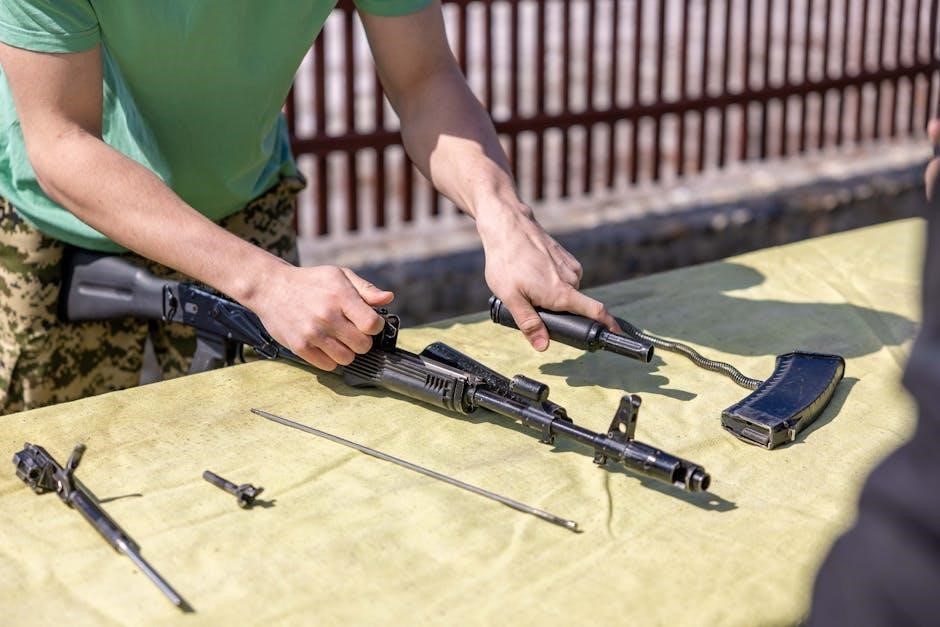
manual safety vs trigger safety
Manual Safety vs. Trigger Safety: A Comprehensive Overview
Firearm safeties broadly fall into manual and internal (trigger) categories, differing in operation and user dependence; standardization remains limited currently.
Firearm safety mechanisms are crucial components designed to prevent accidental discharge, categorized as either manual or trigger-based systems; Manual safeties require conscious user action to disengage, offering a visible indication of the firearm’s status. Conversely, trigger safety, or internal safeties, operate automatically, like drop or sear safeties.
Understanding these distinctions is vital; safe handling relies on knowing how each system functions and recognizing that no safety is foolproof, emphasizing the importance of adhering to fundamental safety rules.
Types of Manual Safeties
Manual safeties include flag (lever), thumb, grip, and crossbolt designs, all requiring deliberate user action to disengage and allow firing.
Flag Safeties (Lever Safeties)
Flag safeties, or lever safeties, are commonly found on some rifles and older pistol designs. These mechanisms utilize a lever, often on the bolt, with positions indicating safety status. Some have three positions – fire, intermediate, and safe – while others offer only two.
Importantly, pistols with this safety aren’t designed for safe carry with a round chambered and hammer back; the hammer must be lowered before holstering, often utilizing a decocking mechanism.
Thumb Safeties
Thumb safeties are a prevalent manual safety type, operated by the shooter’s thumb. They typically block the hammer or firing pin, preventing movement and accidental discharge. These safeties require conscious effort to disengage before firing, placing responsibility directly on the user.
Double-action-only pistols may incorporate thumb safeties, but some designs forgo active safety mechanisms altogether, relying instead on trigger weight for security.
Grip Safeties
Grip safeties function by requiring a firm grip on the firearm to disengage, preventing operation without proper control. These are less common as primary safeties, often serving as secondary mechanisms alongside others. They rely on the shooter maintaining a secure hold, adding a layer of protection against accidental discharge.
However, their effectiveness depends heavily on grip strength and technique.
Crossbolt Safeties
Crossbolt safeties, typically found on single-action revolvers and some older pistols, physically block the hammer from moving forward. They are a robust, positive mechanical safety, requiring deliberate manual operation to disengage. While effective, they can slightly slow down the shooting process due to the added step of manipulating the crossbolt.
These safeties offer a clear visual and tactile indication of their status.

Trigger Safety Mechanisms (Internal Safeties)
Internal safeties, like drop, sear, and firing pin blocks, operate automatically, enhancing safety without relying solely on user manipulation of external controls.
Drop Safety
Drop safety is a crucial internal mechanism preventing unintended discharge if the firearm is dropped. This feature ensures the firing pin cannot move forward unless the trigger is intentionally pulled. It’s a fail-safe design element, independent of the user’s actions, providing an essential layer of security.
This contrasts with manual safeties, which require deliberate engagement. A robust drop safety is paramount, especially in firearms carried for self-defense or duty use, offering peace of mind against accidental activation during impact.
Sear Safety
Sear safety mechanisms prevent the hammer or firing pin from releasing due to accidental movement of the sear – the component holding it back. This internal safety is vital, ensuring a clean trigger pull is required for firing. It functions independently of external manual safeties, adding redundancy.
A properly functioning sear safety is critical for preventing unintended discharges, particularly during handling or transport. It’s a core element of many firearm designs, contributing significantly to overall safe operation and reliability.
Firing Pin Block
Firing pin block mechanisms physically obstruct the firing pin’s movement unless the trigger is intentionally pulled. Often linked to the grip safety or decocker, this internal safety prevents the pin from reaching the primer even if the hammer falls. It’s a crucial layer of protection against drops or impacts;
This design enhances safety by requiring multiple actions to initiate a discharge, minimizing the risk of accidental firing. Modern pistols frequently incorporate firing pin blocks as a standard safety feature, bolstering overall firearm security.
Comparing Manual and Trigger Safeties
Manual safeties rely on user action, while trigger safeties operate automatically; reliability, ergonomics, and user dependence are key distinctions between the two systems.
Reliability and Fail-Safe Design
Evaluating safety mechanisms necessitates considering their reliability and fail-safe characteristics. Manual safeties, while offering positive engagement, depend on consistent user operation. Trigger safeties, conversely, function automatically, potentially providing a more consistent layer of protection. However, their complexity introduces potential failure points.
A truly robust design incorporates redundancy and minimizes the impact of component failure. Ergonomic evaluations, like those conducted by Cornell and Khasawneh (2008), highlight the importance of unambiguous status visibility to ensure proper function and prevent accidental disengagement, bolstering overall reliability.
User Dependence vs. Automatic Operation
A key distinction lies in whether a safety relies on the user’s action (manual) or operates independently (trigger safety). Manual safeties demand deliberate engagement and disengagement, placing responsibility directly on the shooter. This can be a strength, but also a source of error.
Trigger safeties, such as drop or sear safeties, function without direct user input, offering a passive layer of security. However, this automatic operation doesn’t negate the need for diligent safe handling practices, as reliance solely on mechanisms can foster complacency.
Impact of Ergonomics on Safety
Ergonomic design significantly influences safety mechanism effectiveness. Unambiguous status visibility – clearly indicating whether a safety is on or off – is crucial to prevent accidental discharges. Impact-free operation, minimizing unintended disengagement during handling, is equally vital.
Cornell & Khasawneh’s research highlights how ergonomics contribute to understanding firearm safety dynamics, suggesting principles applicable beyond firearms. Effective designs prioritize intuitive operation and reduce the potential for human error through thoughtful placement and tactile feedback.
Standardization of Safety Mechanisms
Currently, there’s a notable lack of standardization in firearm safety mechanism design. Diverse approaches exist across military and commercial rifles, leading to potential user confusion and increased risk. A unified approach to safety features could enhance intuitive operation and reduce accidents.
Evaluating existing designs, as demonstrated by ergonomic studies, can inform the development of more effective and consistent safety systems, ultimately improving overall firearm safety for all users.
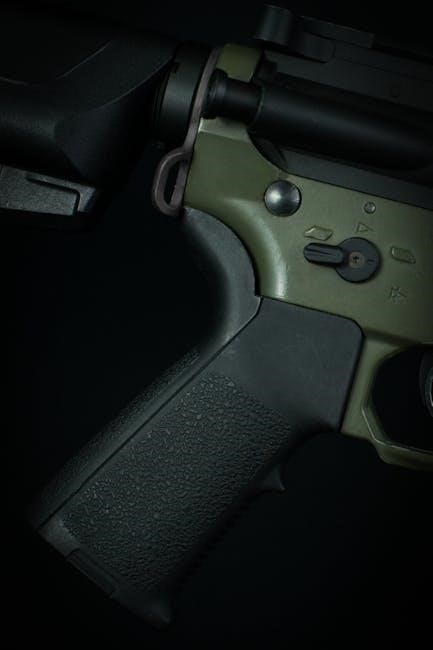
Double-Action/Single-Action (DA/SA) Considerations
DA/SA pistols often incorporate decocking mechanisms to safely lower the hammer, crucial for safe carry and storage when a round is chambered.
Decocking Mechanisms
Decocking mechanisms are vital safety features on many double-action/single-action (DA/SA) pistols, allowing the hammer to be safely lowered without firing a shot. This is particularly important because DA/SA pistols aren’t always designed for safe carry with the hammer back and a round chambered.
These mechanisms provide a controlled descent of the hammer, preventing accidental discharge during holstering or storage. Utilizing a decocker ensures the firearm is in a hammer-down, safer configuration, reducing the risk of unintentional firing, and is a key consideration for responsible firearm handling.
Hammer-Down Safety
Hammer-down safety relies on the principle that a lowered hammer presents a significantly reduced risk of accidental discharge compared to a cocked position. This is a core safety feature in many DA/SA pistols, often achieved through decocking mechanisms or deliberate manual lowering of the hammer.
While not a foolproof system, a hammer-down configuration requires a longer, heavier trigger pull for the first shot, providing an additional layer of safety against negligent discharge. It’s a fundamental practice for safe handling and storage.
Double-Action Only (DAO) Pistols
DAO pistols often lack external safeties, relying instead on a consistent, heavier trigger pull for every shot, enhancing inherent safety features.
Absence of External Safety
Double-action only (DAO) pistols are frequently designed without a manual, external safety lever. This deliberate omission simplifies operation and reduces the potential for human error related to engaging or disengaging a safety. The firearm’s safety is entirely dependent on the mechanical resistance of the trigger itself. This heavier trigger pull requires a conscious effort with each shot, minimizing the risk of accidental discharge. Consequently, users must consistently practice safe handling procedures, as there isn’t a separate mechanical safety to rely upon.
Reliance on Trigger Weight
DAO pistols prioritize safety through a consistently heavier trigger pull, functioning as the primary safety mechanism. This increased resistance demands deliberate action, reducing the likelihood of unintentional discharge. While lacking an external safety, the substantial trigger weight necessitates focused control. Safe handling practices remain paramount, as the heavier pull isn’t foolproof. Regular training reinforces proper technique and awareness, compensating for the absence of a manual safety lever and promoting responsible firearm operation.
The Three Rules of Firearm Safety
Essential firearm safety dictates treating every gun as loaded, never pointing at unintended targets, and keeping your finger off the trigger until ready.
Treat Every Gun as Loaded
Assuming a firearm is loaded, regardless of prior checks, fosters a consistently cautious mindset crucial for preventing accidental discharges. This principle transcends safety mechanisms – manual or internal – as they can fail. Reliance on a safety, whether a lever, thumb lock, or firing pin block, is insufficient.
Consistent adherence to this rule reinforces responsible handling, minimizing the risk of negligent actions. It’s a foundational element, overriding any perceived security from the gun’s design.
Never Point at Anything You Don’t Intend to Shoot
Muzzle discipline is paramount, irrespective of whether a firearm has manual or trigger safeties. A safety mechanism doesn’t alter the projectile’s path once the trigger is pulled. Maintaining constant control over the firearm’s direction prevents unintended harm, even with a functioning safety.
This rule emphasizes responsible behavior, recognizing that a safety isn’t a substitute for careful aiming and awareness of the surrounding environment. It’s a core tenet of safe gun handling.
Keep Your Finger Off the Trigger Until Ready to Fire
This rule is crucial, regardless of safety type – manual or internal. A safety mechanism won’t prevent accidental discharge from a flinch or stumble. Maintaining a relaxed finger position outside the trigger guard minimizes the risk of unintentional firing.
This practice reinforces deliberate action; the trigger should only be engaged as a conscious part of the shooting process, enhancing control and preventing negligent discharges.
AR-15 Rifle Safety Features
AR-15 rifles require diligent field stripping and safety checks to ensure proper function, complementing both manual and internal safety mechanisms for secure handling.
Field Stripping and Safety Checks
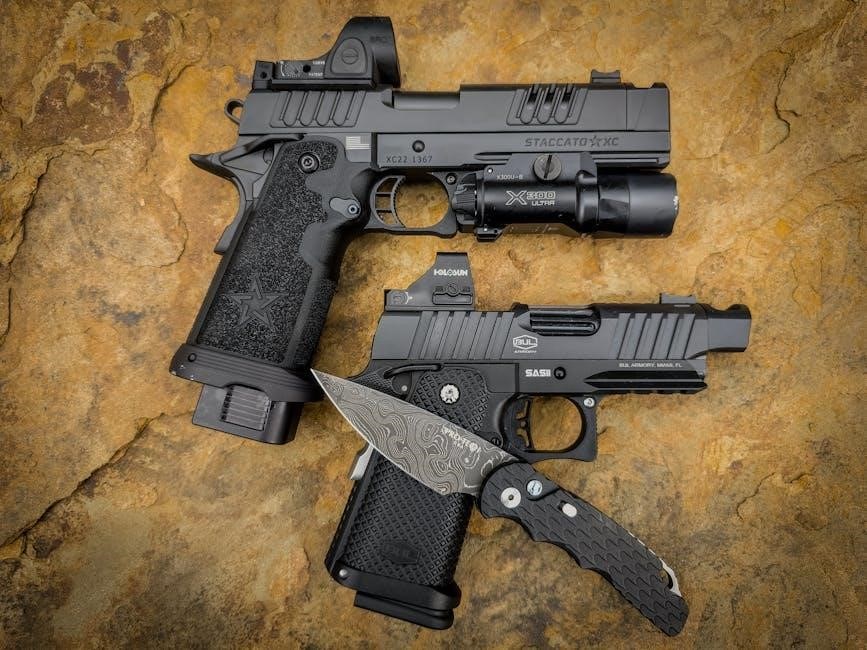
Regular field stripping of an AR-15 is crucial, allowing for a thorough inspection of internal components and verifying the functionality of both manual and trigger safety features. This process confirms the absence of obstructions and ensures proper engagement/disengagement. Always perform safety checks with the firearm unloaded, visually and physically inspecting the chamber, magazine well, and bore. Prioritize understanding how the safety mechanisms – lever, sear, and firing pin block – interact during disassembly and reassembly. Consistent practice builds familiarity and reinforces safe handling procedures, minimizing potential for human error and maximizing firearm reliability.
Ergonomic Evaluation of Safety Designs
Effective safety designs prioritize unambiguous status visibility and impact-free operation, crucial for intuitive use and minimizing accidental disengagement during handling.
Unambiguous Status Visibility
A critical ergonomic factor is the ability to instantly and clearly determine whether a firearm’s safety is engaged or disengaged, without ambiguity. This necessitates distinct visual indicators – colors, markings, or physical positions – readily perceivable at a glance. Poorly designed safeties can lead to user error, assuming the firearm is safe when it isn’t. The research highlights that clear status visibility significantly contributes to safer handling practices, reducing the potential for negligent discharges and enhancing overall firearm safety. This is paramount for both manual and trigger-based systems.
Impact-Free Operation
Ergonomic safety design demands mechanisms that don’t require excessive force or awkward movements to engage or disengage. Safeties should operate smoothly and intuitively, minimizing the risk of unintentional activation or deactivation during handling. Jerky or stiff actions can compromise grip and control, potentially leading to errors. Impact-free operation ensures the user maintains a firm, stable hold on the firearm while manipulating the safety, contributing to safer and more reliable operation in stressful situations.

Military vs. Commercial Safety Designs
Design variations exist between military and commercial firearms, impacting effectiveness; ergonomic evaluations of five designs determined characteristics for future incorporation.
Design Variations and Effectiveness
Existing firearm safety designs, found on both military and commercial rifles, exhibit considerable variation, lacking present standardization. An ergonomic investigation evaluated five designs, focusing on unambiguous status visibility and impact-free operation – key components for safety mechanism design. These elements aren’t limited to firearms, potentially influencing broader safety mechanism development. The research highlights how ergonomics contribute to understanding firearm safety dynamics, aiming to incorporate the most effective characteristics into future designs for enhanced reliability and user safety.

Safe Handling Practices
Proper firearm handling includes secure holstering, careful storage, and consistent visual safety checks, reinforcing the importance of responsible gun ownership.
Holstering and Storage
Safe holstering practices are paramount, especially with firearms lacking automatic safeties; always lower the hammer before holstering. Secure storage, utilizing gun safes or lockboxes, prevents unauthorized access and accidental discharge. Remember, even with safeties engaged, treat every firearm as loaded. Consistent adherence to these practices minimizes risk and promotes responsible gun ownership, regardless of the safety mechanisms present. Proper storage also protects against theft and misuse, contributing to overall public safety.
Visual Safety Indicators
Unambiguous status visibility is crucial for both manual and trigger safeties; users must instantly recognize if a firearm is ready to fire. Clear indicators, like a visible safety lever or color-coded markings, reduce the potential for errors. Ergonomic evaluations highlight the importance of intuitive designs. These indicators complement, but do not replace, the fundamental rules of firearm safety; Relying solely on visual cues is insufficient; constant vigilance remains essential for responsible handling.

Potential for Human Error
Over-reliance on safety mechanisms and complacency can lead to negligence, underscoring the critical need for consistent adherence to firearm safety rules.
Over-Reliance on Safety Mechanisms
A dangerous pitfall arises when shooters develop a false sense of security due to the presence of safeties, both manual and internal. These mechanisms are aids, not substitutes, for diligent safe gun handling practices. Complacency can quickly override training and awareness.
Assuming a safety guarantees absolute protection can lead to negligent actions, like improper holstering or failing to maintain a secure grip. Remember, safeties can fail, and human error remains the most significant factor in firearm accidents; vigilance is paramount.
Complacency and Negligence
Repeated safe handling, ironically, can breed complacency, diminishing attentiveness to fundamental safety rules. Negligence stems from a lack of consistent focus and a disregard for potential hazards. This manifests as shortcuts in procedures, like failing to visually confirm a safety’s status.
Such lapses, combined with over-reliance on mechanical safeties, create a dangerous environment. Consistent reinforcement of the three firearm safety rules is crucial to combatting this, ensuring mindful operation every time.
Future Trends in Firearm Safety
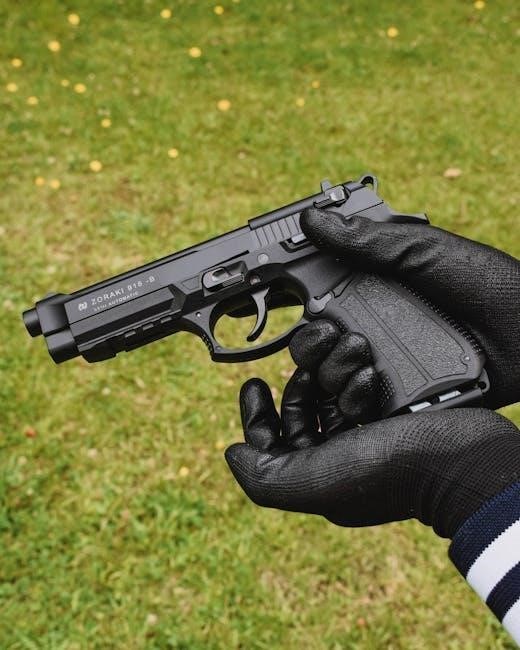
Advanced technologies and improved ergonomic designs are poised to enhance firearm safety, building upon current mechanisms and addressing human factors effectively;
Advanced Safety Technologies
Emerging technologies aim to surpass traditional manual and trigger safeties, focusing on fail-safe designs and minimizing reliance on user action. Research explores biometric integration – utilizing fingerprint or grip recognition – for authorized firearm operation. Smart guns incorporating these features could drastically reduce accidental discharges and unauthorized use.
Furthermore, electronically controlled firing pin blocks and dynamic safety systems adapting to handling conditions represent promising avenues. These innovations prioritize unambiguous status visibility and impact-free operation, crucial ergonomic components for enhanced safety.
Improved Ergonomic Designs
Future firearm safety hinges on designs prioritizing intuitive operation and minimizing human error. Key improvements center on unambiguous status visibility – instantly knowing if a firearm is safe – and impact-free operation, preventing accidental disengagement. Research highlights the need for controls easily accessible without altering a secure grip.
Ergonomic evaluations, like those conducted by Cornell & Khasawneh, inform designs reducing reliance on dexterity or memory, ultimately enhancing safety for all users.